Top Things to Do in Nouakchott

Top Things to Do in Nouakchott

4 must-see attractions and experiences

Nouakchott rises from the Sahara's edge like a city still negotiating its own existence. Founded in 1958 as a modest administrative post for a newly independent nation, it has expanded into a large Atlantic coastal capital where sand blows through wide, partly paved avenues and the smell of dried dates, frankincense, and ocean salt mixes in ways that exist nowhere else on the continent. For travelers conditioned to North African capitals with ancient medinas and layered imperial histories, Nouakchott reorients expectations entirely. This is a young city, raw and unsentimental, and its character comes from two forces pressing against each other: the Sahara Desert at its back and the cold, fish-rich Atlantic at its face. What the city offers is not a curated tourist circuit but an immersion in Mauritanian daily life at a scale and intensity that most West African capitals no longer provide. At the Port de Pêche before dawn, hundreds of painted pirogues return with the Atlantic catch while pelicans circle low and the sharp smell of brine fills the cool morning air. The call to prayer from the Saudi Mosque carries across flat, ochre-toned neighborhoods with an authority the city's low skyline does nothing to muffle. Streets fill with men in flowing blue boubous and women in bright melhafas, the draped silk garment particular to Mauritanian women, moving between markets where bolts of cloth, dried herbs, and camel-leather goods are sold with the quiet assurance of people who have been trading across desert routes for centuries. First-time visitors to Nouakchott should arrive with patience and calibrated expectations. The city rewards those who slow down long enough to accept the three rounds of sweet, mint-heavy Saharan tea that constitute the primary social currency here, and who resist the impulse to rush through its modest inventory of formal attractions. The dry season between November and February brings temperatures that feel merely warm rather than punishing, and the harmattan winds deposit significantly less grit than the ferocious summer months. Safety in the city center is generally not a concern for travelers exercising ordinary urban awareness, and Mauritanians themselves tend toward a reserve that is courteous rather than cold. Nouakchott is a place that asks for a little time before it gives anything back, and the return on that patience is genuine.

Don't Miss These

Our top picks for visitors to Nouakchott

Galerie Zeinart

Museums & Galleries

Tucked into a quiet corner of central Nouakchott, Galerie Zeinart is the city's most serious and sustained space for contemporary Mauritanian art. The gallery exhibits paintings, photography, and mixed-media works by local and regional artists, offering an encounter with Mauritania's visual culture that exists entirely outside the context of traditional crafts or ethnographic display: canvases layered with desert ochres and deep indigo blues, photographs that fix the faces of nomadic communities in sharp, lasting focus, sculptural objects that draw from the desert's geometry without being reducible to it. Stepping inside from the sandy glare of the street, the cool interior and measured silence feel like a genuine recalibration, and the works on its walls tell stories that the country's otherwise limited cultural infrastructure rarely surfaces for visitors.

1-2 hours Budget Morning
Galerie Zeinart offers the most direct encounter available with Mauritania's living artistic identity, distilled into a single navigable space with real curatorial intention.
Insider tip: Visit on a weekday morning when foot traffic is lightest and the gallery staff are most likely to speak at length about individual works. The context they provide transforms what you are looking at from interesting objects into a coherent artistic conversation.

Mauritanian National Museum

Museums & Galleries

The Mauritanian National Museum is the essential starting point for any visitor who wants to understand what they are looking at when they travel through this country. Its collections move through prehistoric rock carvings, ancient manuscripts from Chinguetti and the Saharan scholarly centers of the medieval period, traditional jewelry and textiles, and archaeological material from the Berber and Almoravid eras, all arranged to trace a coherent arc through Mauritanian history that the landscape alone cannot convey. The manuscripts room is arresting: volumes sit behind glass that carries the faint smell of old leather and age, the physical remains of a scholarly tradition that once made the Mauritanian Sahara the intellectual center of West Africa, drawing students and copying texts in Arabic script across subjects ranging from astronomy to jurisprudence to mathematics.

2-3 hours Budget Morning
No other institution in Nouakchott synthesizes the country's layered Berber, Arab, and sub-Saharan African heritage with this degree of material evidence and historical seriousness.
Insider tip: The ethnographic wing receives far less foot traffic than the manuscript displays and is worth spending time in. The traditional tent-construction tools and camel-leather domestic objects still carry faint traces of lanolin, and the accompanying explanatory panels make clear how Saharan nomadic life achieves a kind of engineering precision that its apparent informality conceals.

Saudi Mosque

Cultural Experiences

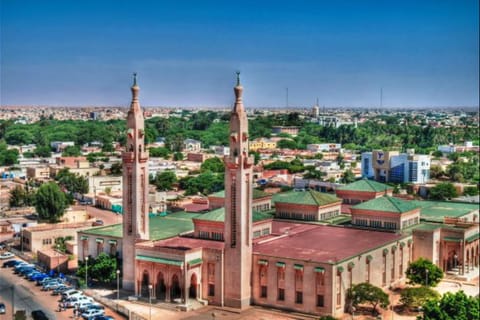
Formally known as the King Fahad Mosque, funded by Saudi Arabia and completed in the 1980s, the Saudi Mosque is among the most architecturally commanding structures in Nouakchott, its white minaret rising against an improbably saturated Atlantic sky with a geometric clarity that cuts through the city's otherwise low and sun-bleached profile. The scale of the complex, with its broad marble forecourt where the afternoon sun creates pools of shimmering heat, conveys the same kind of civic and spiritual weight that great mosques carry throughout the Islamic world, and approaching the building at sunset, when the call to prayer fills the warm air and the sky turns the deep orange of cooling coals, is one of Nouakchott's most quietly moving experiences. Non-Muslim visitors are typically welcomed outside the five daily prayer times, and the forecourt itself provides an unobstructed vantage point from which the city's geography, flat and vast in every direction, suddenly makes sense.

30-60 minutes Free Late afternoon to evening
The Saudi Mosque represents the spiritual and architectural center of Nouakchott, and the experience of the Maghrib call to prayer from its forecourt is unlike anything else the city offers.
Insider tip: Arrive in the half-hour before sunset rather than immediately after, when the forecourt begins to fill and the quality of light on the white exterior is at its best. Dress conservatively with shoulders and knees covered, and women should bring a lightweight scarf for the head. Remove shoes before entering any covered area of the complex.

Sidi Tours Mauritania

Day Trips

With a near-perfect rating across dozens of verified traveler reviews, Sidi Tours Mauritania is the single most consequential booking a visitor to Nouakchott can make. The company runs day trips and multi-day expeditions into the landscapes that define this country at its most extraordinary: the palm-shaded freshwater springs of Terjit oasis, where cool water flows through canyon walls the color of dried blood. The ancient caravan city of Chinguetti with its crumbling library towers and the sound of wind moving over dunes that abut the town's outer walls. The prehistoric rock paintings scattered across the Adrar plateau, where ochre handprints and animal silhouettes pressed into stone thousands of years ago remain legible in the afternoon light. The guides are knowledgeable, reliably English-speaking, and familiar with desert logistics and pacing, converting what could feel like an overwhelming, featureless expanse into a comprehensible terrain with named features, human histories, and navigable rhythms.

Full day to multi-day Moderate Morning departure
Sidi Tours Mauritania unlocks the Saharan interior that most visitors to Nouakchott never reach, and the desert landscapes within a day's drive of the capital are among the most extraordinary in West Africa.
Insider tip: If only one day outside the city is available, the Terjit oasis excursion offers the most concentrated sensory contrast to Nouakchott's coastal dryness. The cool shadow of the canyon walls, the sound of water moving over stone, and the smell of date palms in the heat are a complete counterpoint to everything the city provides, and the drive through the desert registers as a landscape of its own.

Planning Your Visit

Practical tips for getting the most out of Nouakchott

Best Time to Visit
November through February offers the most livable conditions, with days that feel warm rather than scorching and nights that cool substantially after sunset. The coastal breeze off the Atlantic becomes a genuine comfort rather than a vehicle for blowing grit, the sky clears, and the harsh harmattan winds that characterize the spring and summer months settle into something more manageable.
Booking Advice
Sidi Tours Mauritania merits advance planning, for multi-day desert excursions during the November-to-February season when the most experienced guides are booked out. The Mauritanian National Museum and Galerie Zeinart operate on standard daytime hours and do not typically require reservations, though arriving early in the morning ensures the fullest attention from staff.
Save Money
Mauritanian mint tea is served without charge at nearly every shop, guesthouse, and informal interaction in Nouakchott, and accepting it gracefully is both culturally appropriate and one of the most reliable ways to experience the city's social texture without any expenditure. The fish stalls and grills near the Port de Pêche area offer some of the freshest seafood available at prices that make sit-down restaurant meals look unnecessarily extravagant by comparison.
Local Etiquette
Mauritania observes Islamic social norms with consistency, and visitors who accommodate them encounter an easier and more open city. Dress modestly throughout Nouakchott, with loose clothing covering shoulders and knees as a minimum. Women traveling without male companions will feel considerably more comfortable with a lightweight covering for the arms and hair. Photographing individuals without explicit consent, ideally after a brief conversation, is considered rude rather than a minor transgression, and the most rewarding portraits come from interactions rather than from pointing a camera without asking. During Ramadan, eating, drinking, or smoking in public during daylight hours is both socially inappropriate and subject to legal restriction. Greetings in Hassaniya Arabic, even a simple marhaba, are received with real warmth and typically open doors that staying silent keeps closed.

Explore more experiences in Nouakchott

Browse live availability and pricing.

Didn't see anything interesting yet?

Browse Viator's full catalog of tours, day trips, food experiences, and private guides in Nouakchott.

See All Nouakchott Tours on Viator